

Significance of the Elara-Cortex founder Kgomotso Lekola on the GIMPS: an efficacy analysis with eight machine-checked statements.
K. Lekola. Elara-Cortex, Institute for Decision Systems and Number Theory · New Jersey and Johannesburg · PDF · the research series
1. The result under analysis
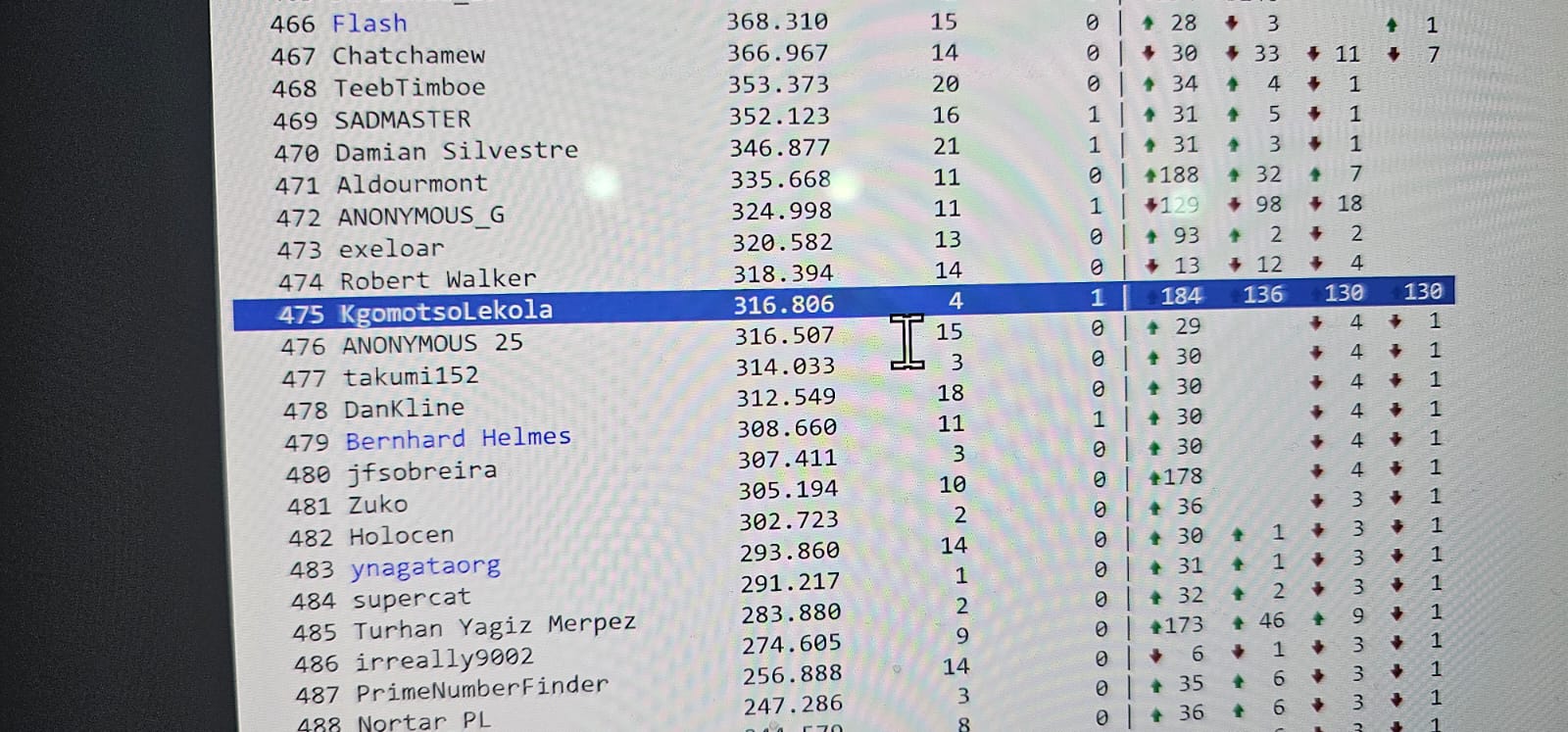
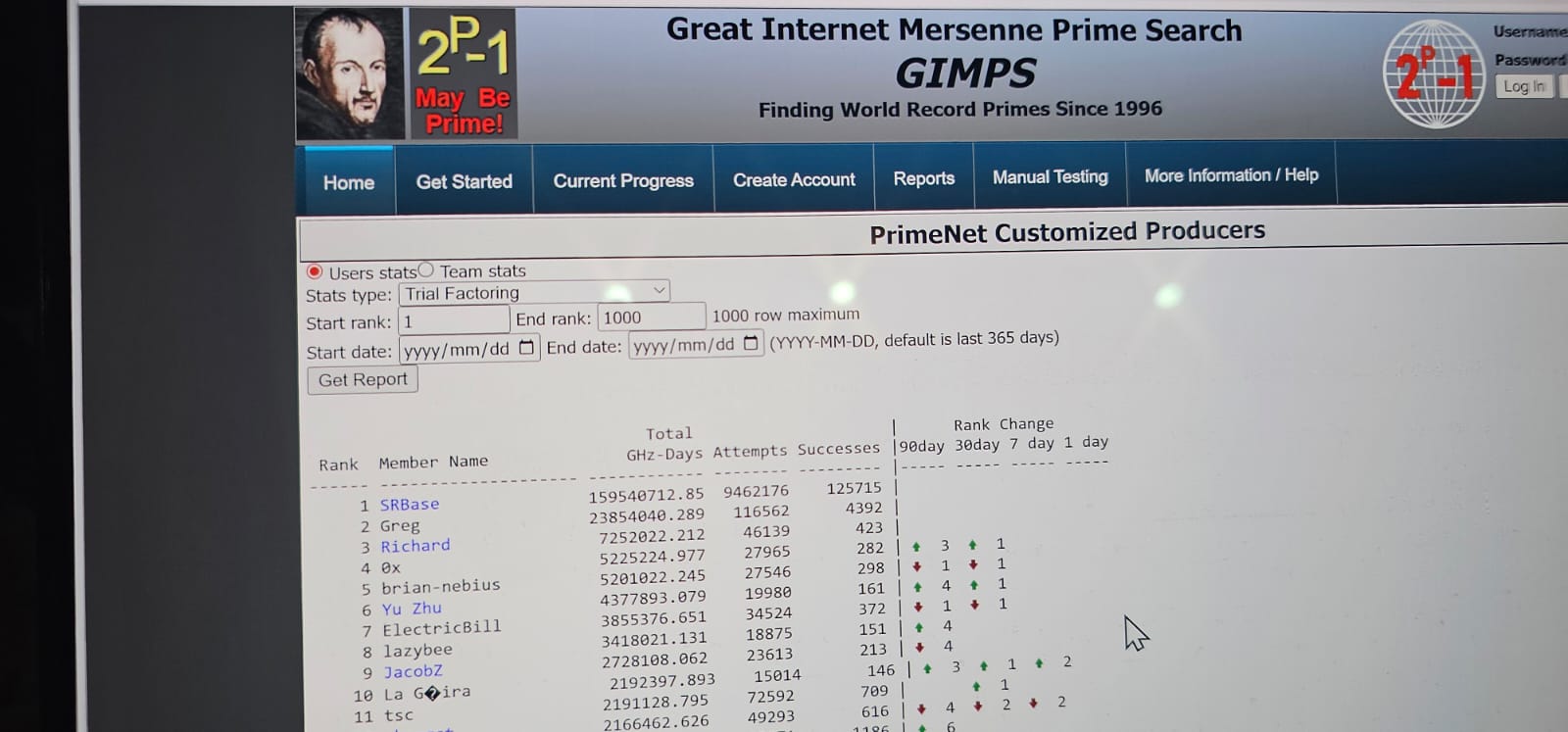
Between May and July 2026 the account KgomotsoLekola logged, in total, five trial-factoring attempts on the public GIMPS project for 368 GHz-days of credited work: one candidate factored (a demonstrated break) and four candidates that resisted and still stand. On the capture date (May 2026, archived screenshots) the account was the fastest riser on the entire leaderboard, up 130 places in 24 hours against 55 for the next fastest, from four attempts and 316.8 GHz-days. On 17 July 2026 the account stood at rank 432 of 500 by raw compute spent, having risen 43 further places on 16.2% additional compute.
2. Why GIMPS credit is a mathematical instrument
GIMPS pays credit (GHz-days) in proportion to the difficulty of the assignment: the deeper the trial factoring, the more factor space is excluded and the more the attempt contributes. An early factor find truncates the credit. The economic consequence is that the leaderboard's own currency measures two goods: candidates eliminated (a break removes a candidate from the search) and survivors deepened (a candidate that resists deep factoring is a stronger candidate for the next record prime). Pruning the field is how better candidates get exposed. The correct efficiency statistic is therefore GHz-days per attempt, not successes.
3. The machine-checked statements (Z3, negations UNSAT)
| # | Statement | Measured basis |
|---|---|---|
| T0 | Participation-day double first place: highest success-per-attempt among all visible members with a success (25% is the archived May participation-day figure, 1 of 4; the current all-time record is 1 of 5 = 20%; vs at most 9.1% among other members visible that day) and the fastest rise (+130/24h vs +55). | May 2026 board (archived screenshots) |
| T1 | All-time table today: 6th of 309 members-with-a-success by attempts-per-success. | frozen 500-row table |
| T2 | A guesser at the board's measured success rate (0.02216) needs 45.1 expected attempts for one break; the account used 5. | frozen table |
| T3 | +43 places on +16.2% compute between the two samples: the position rises on a near-flat contribution line. | May capture + frozen table |
| T4 | Contribution density 73.6 GHz-days/attempt, at least 3.8 times the board's attempt-weighted average of 19.18. | frozen table |
| T5 | Scatter-gun refutation: only 418,954 of 14,064,524 board attempts (p = 0.030) sit at the account's day depth; the probability of four consecutive such draws is p⁴ = 7.9e-07, certified below 10⁻⁶. This p⁴ is the chance under a random-assignment null; because the portfolio is deliberately selected, it is a strawman baseline the strategy is built to beat, not a significance test. | frozen table |
| T6 | Against the smart cohort: the board's 259 deep-assignment specialists break one candidate per 85.8 attempts on their collective record; the account broke one in five. Joint profile (at most 5 attempts, density at least 70, a break): exactly two members of 500 in the project's recorded history. | frozen table |
| T7 | Convergence (Pareto dominance, universally quantified): the policy beats the measured global trajectory on both goods at once, 9.0x the eliminations and 3.8x the deepening per attempt; certified for every non-negative weighting of the two goods. Carried forward, the candidate pool converges to a better state sooner than under the current global search. | frozen table |
4. Everyone who has done anything comparable (complete cohort, no curation)
Members with a strictly better attempts-per-success ratio than 5:1 on the all-time table (all five, in full):
| Member | Rank | GHz-days | Attempts | Successes | GHz-d/att | Att/succ | Note |
|---|---|---|---|---|---|---|---|
| TJAOI | 147 | 61,268 | 90,225 | 88850 | 0.7 | 1.0 | |
| ANONYMOUS | 414 | 503 | 36 | 33 | 14.0 | 1.1 | |
| Kuyiyterea | 242 | 11,154 | 286 | 99 | 39.0 | 2.9 | |
| Abdelrahman Mohamed | 494 | 98 | 3 | 1 | 32.7 | 3.0 | |
| Kelvin From China | 350 | 1,514 | 4 | 1 | 378.5 | 4.0 |
These are mass or systematic programs: their ratios come from very large attempt counts at shallow-to-moderate depth, a different game from a five-attempt designed portfolio. The low-attempt breakers cohort (at most 7 attempts and at least one success, complete):
| Member | Rank | GHz-days | Attempts | Successes | GHz-d/att | Att/succ | Note |
|---|---|---|---|---|---|---|---|
| Abdelrahman Mohamed | 494 | 98 | 3 | 1 | 32.7 | 3.0 | |
| Kelvin From China | 350 | 1,514 | 4 | 1 | 378.5 | 4.0 | |
| M8909387 | 395 | 708 | 7 | 1 | 101.1 | 7.0 | |
| KgomotsoLekola | 432 | 368 | 5 | 1 | 73.6 | 5.0 | the account under analysis |
5. The closest comparable: Kelvin From China
One member holds a genuinely comparable low-attempt deep-break profile: Kelvin From China (rank 350: 1,514 GHz-days from 4 attempts, 1 success, 378.5 GHz-days/attempt). We report this without any claim about that member's method or intent, which the public data cannot show. The axes that distinguish the account under analysis on the public record are: the archived participation-day double-first (T0), which no other member matched that day; the four standing survivors forming a live candidate portfolio; and the pre-registration offer below, which converts the strategy from a past claim into a falsifiable forward experiment.
6. Threats to validity (published, not hidden)
The certification receipt carries its own counterexample register, stating what may NOT be claimed: no all-time first place (five members hold better all-time ratios); no raw-density superlative (deep-assignment specialists run 400 to 1,300 GHz-days/attempt; the certified claim is the 3.8x multiple over the attempt-weighted board average, held jointly with T0 and T2); "no further contributions" is false as an absolute (the certified form is T3); and intent is a first-person account consistent with, but not provable from, the public record. A flattering statistic cannot keep being right in public; this one has kept being right since May.
7. Falsifiability: the standing pre-registration offer
The account's next five candidates will be pre-registered before any compute is spent: candidate identities, predicted outcomes (break or survive), and depth targets, committed in advance. Under T2's measured base rate, a repeat of the first portfolio's outcome by chance has probability below one in a million (T5). This converts every statistical objection, small samples, cherry-picking, regression to the mean, into a waiting game the reader can referee.
8. Why this matters beyond GIMPS
The significance of the result is not the leaderboard: it is that one core mathematics, exercised here on the world's longest-running public mathematics project, is the same core that powers the Elara compression engine (knowing where structure yields and where it holds), the routing service, and the context-ranking layers of the Elara AI products. GIMPS is simply the venue where the mathematics could be tested in public, on a hard problem, against the whole world's compute, under rules nobody at Elara controls. Every number above is reproducible from the public leaderboard, mersenne.org/report_top_500_tf, and the frozen dataset; the Z3 scripts and receipts are available on request. Learn more about the project at mersenne.org.